


If you live in Melbourne, you already know the joke — four seasons in one day. But for your lawn, that’s no laughing matter. Victoria’s swinging temperatures, scorching summer dry spells, frosty winter mornings, and unpredictable rainfall create some of the most demanding conditions for residential turf in Australia. When your lawn starts showing patches, thinning, yellowing, or bare spots, it’s rarely a single problem — and that’s exactly why generic lawn repair products from the hardware store so often fall short.
Professional lawn care that’s calibrated to Victoria’s specific seasonal pressures, soil types, and turf varieties is the most reliable path to a healthy, resilient lawn. Whether you’re in Melbourne’s outer suburbs, Geelong, Bendigo, Ballarat, or Shepparton, this guide will help you understand what’s affecting your lawn and what genuine, lasting repair looks like.
Why Victorian Lawns Are Under More Pressure Than Most
Victoria’s climate is genuinely unique among Australian states — and it creates a specific set of challenges for homeowners trying to maintain healthy turf.
The Melbourne Climate Problem
Melbourne’s climate sits in a transition zone that means warm-season grasses struggle through cold winters while cool-season grasses bake in summer. Most suburban Melbourne lawns feature Buffalo, Kikuyu, or Couch varieties — all warm-season grasses that go semi-dormant in winter and become vulnerable to weeds filling the gaps.
Then summer arrives and brings prolonged heat waves, water restrictions, and rapid moisture evaporation that stresses root systems. By late summer and autumn, lawns that looked reasonable in spring are often patchy, brown, and depleted.
Soil Conditions Across Victoria
Soil types vary significantly across the state. Greater Melbourne’s suburban areas often have clay-heavy soils that compact easily, reducing root penetration and water absorption. In regional areas like Bendigo and Ballarat, soils can be sandy and free-draining, leading to rapid nutrient loss and drought stress. Geelong’s coastal soils present their own challenges with salt exposure and variable moisture.
This is why a treatment approach that works in Brisbane or Perth won’t necessarily produce the same results in Victorian conditions. Local knowledge matters.
The Most Common Causes of Lawn Damage in Victoria
Accurate diagnosis is the foundation of any effective lawn repair program. Victorian lawns are susceptible to a specific cluster of problems that compound quickly when left untreated.
Lawn grubs and soil pests are most active in Victoria from late summer through autumn. Scarab grubs, African black beetles, and armyworms target the root zone and surface leaf material, leaving irregular brown patches that don’t respond to watering.
Hydrophobic soils are widespread across Melbourne’s clay-based suburbs. When soil becomes water-repellent, rainfall and irrigation simply run off the surface rather than penetrating to the roots — leaving lawns parched even after rain.
Fungal lawn disease thrives in Victoria’s spring and autumn conditions, when cool nights follow mild, humid days. Dollar spot, brown patch, and helminthosporium cause characteristic ring-shaped or irregular dead patches that are frequently mistaken for drought damage.
Weed infiltration accelerates through winter when warm-season lawns like Buffalo and Kikuyu slow their growth and lose their competitive density. Winter grass, bindii, clover, and oxalis establish quickly and are difficult to remove without professional treatment.
Nutrient depletion occurs rapidly in Melbourne’s clay soils after seasonal rainfall leaches nitrogen and key nutrients, while the high mowing frequency most homeowners maintain strips leaf material before the plant can photosynthesise efficiently.

How to Repair a Patchy Lawn in Melbourne — What Actually Works
The instinct when you see a deteriorating Melbourne lawn is to grab a bag of fertiliser or a hose nozzle. In most cases, that treats a symptom without touching the cause. Here’s what effective lawn repair actually requires.
Step 1 — Accurate Diagnosis First
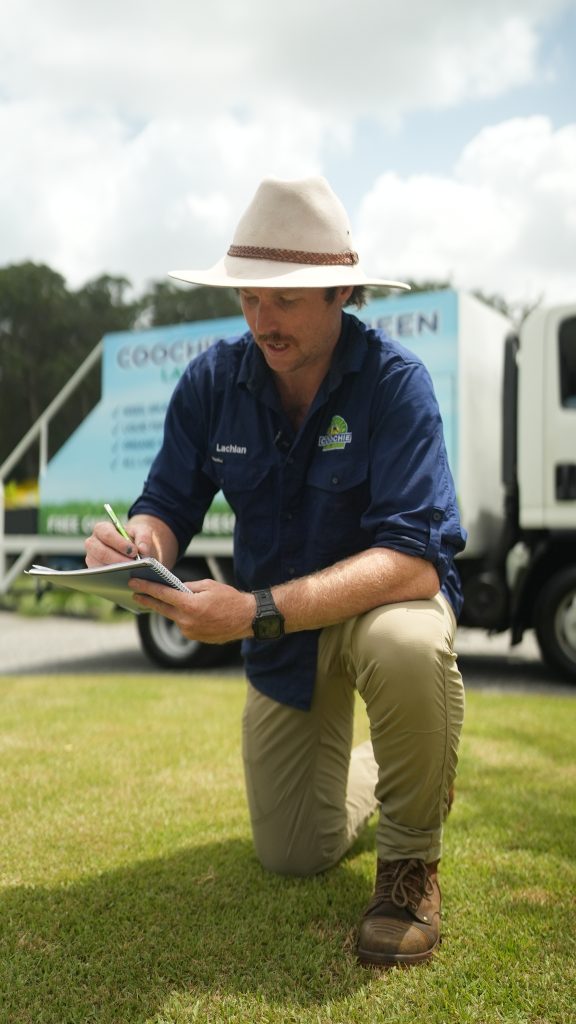
Before any product is applied, the underlying cause needs to be identified. A professional assessment covers:
- Turf variety and its specific growth requirements
- Soil pH, compaction level, and moisture retention capacity
- Active pest populations (including grub inspection beneath the turf line)
- Signs of fungal disease
- Weed species present and their growth stage
- Nutrient deficiency indicators
Getting this right at the start prevents the most common mistake in lawn repair: treating the wrong problem.
Step 2 — Targeted Professional Treatment
Once the cause is confirmed, targeted treatment begins. This is where commercial-grade products applied by a licensed and insured technician consistently outperform DIY approaches. The right product, at the right concentration, applied at the right time of year for Victorian conditions, produces results that hold.
Step 3 — A Seasonal Maintenance Program
One-off treatments don’t prevent the problem from returning. A scheduled lawn care program delivers treatments timed to each season’s specific threats — protecting your lawn before problems take hold rather than scrambling to fix them after the damage is done.
Coochie HydroGreen’s Lawn Repair and Lawn Care Program — Built for Victorian Conditions
At Coochie HydroGreen, our Lawn Care Program is specifically structured around the seasonal pressures Victorian lawns face. We don’t replace or re-seed turf — we restore it, using a scientifically formulated treatment approach tailored to your turf type, soil, and suburb.
Our 6-in-1 liquid lawn treatment is the engine of the program, delivering six distinct benefits in a single application:
- Liquid fertilisers — fast-acting nutrients matched to your turf’s current deficiency, stimulating recovery and new growth
- Organic soil conditioners — improve soil structure and microbial activity, particularly important for Melbourne’s compacted clay soils
- Soil moisture retainers — critical for hydrophobic Victorian soils where water repellency undermines every other treatment
- Weed control — targeted to the specific weed species present in your lawn at that time of year
- Pest control — breaks the grub life cycle and eliminates existing infestations before they strip your root zone
- Disease management — protects against Victoria’s seasonal fungal threats during spring and autumn
The program runs 6 visits per year on a bi-monthly schedule, aligned to Victoria’s seasonal calendar — so every treatment addresses what your lawn actually needs right now, not a generic formula applied on autopilot.
There’s no lock-in contract and all services are pay-as-you-go. Every treatment includes a service warranty, meaning if something isn’t tracking correctly between scheduled visits, your local Victorian technician comes back at no additional charge.
Winter Lawn Care in Victoria — The Season Most Homeowners Get Wrong
Winter is when Victoria’s warm-season lawns are at their most vulnerable, and it’s the season most homeowners effectively stop looking after their turf until things go wrong in spring.
A common pattern plays out every year: lawn slows through June and July, weeds quietly establish in the thin areas, then suddenly in September the lawn looks far worse than it did in autumn. By this point, the winter weed population is entrenched and recovery takes months instead of weeks.
What good winter lawn care in Victoria looks like:
- Pre-emergent weed control applied in autumn before winter grasses germinate and take hold
- Slow-release nutrient applications to maintain root zone health through dormancy without triggering excessive top growth
- Disease monitoring — autumn and spring in Victoria are peak risk periods for fungal turf diseases; early identification stops them spreading
- Soil conditioning — addressing compaction and hydrophobia before spring growth begins maximises the response to spring fertilisation
Homeowners who maintain their lawn care program through winter consistently achieve a faster, fuller spring recovery than those who pause treatments and restart in September.
Victorian Suburbs and Regions We Service
Coochie HydroGreen operates across Victoria’s major metropolitan and regional areas. Our local technicians understand the specific soil types, climate patterns, and turf varieties common to each area — so your treatment program is genuinely tailored to your suburb, not just your postcode.
We service Victorian homeowners, strata managers, and commercial properties across:
- Melbourne metro — including inner, northern, eastern, western, and southeastern suburbs
- Geelong and Surf Coast — including Ocean Grove, Torquay, and surrounding coastal areas
- Bendigo — inland Victoria where sandy, free-draining soils demand specific nutrient management
- Albury — border region with Coochie HydroGreen technicians servicing both sides
If you’re unsure whether your suburb is covered, call 1800 245 955 and our team will confirm availability and connect you with your local Victorian technician.
Frequently Asked Questions About Lawn Repair and Lawn Care in Victoria
Why does my Melbourne lawn look worse after winter?
Melbourne’s warm-season lawns (Buffalo, Kikuyu, and Couch) slow their growth significantly through winter. This creates gaps in the turf canopy that weeds — particularly winter grass, bindii, and clover — fill rapidly. By the time growth resumes in spring, the weed population is well established. The most effective way to prevent this is a pre-emergent weed control application in autumn, combined with a winter soil conditioning treatment that keeps the root zone healthy through dormancy. A professional lawn care program timed to Victoria’s seasonal calendar addresses this proactively.
Can a professional treatment revive a lawn that looks completely dead after summer?
In most cases, yes. What looks like a dead Victorian lawn after a dry Melbourne summer is usually a dormant or severely stressed turf that still has viable root crown material. A professional assessment will confirm whether the root system is intact. If roots are present, targeted fertilisation, soil conditioning, and moisture retention treatment can often produce visible new growth within two to four weeks of the first application. Complete, lasting recovery typically takes three to six months depending on the extent of damage.
What are the most common lawn pests in Victoria?
The most active lawn pests in Victorian residential turf are African black beetles, scarab grubs, and armyworms — all of which peak in activity from late summer through autumn. Black beetles damage turf both as larvae (feeding on roots) and as adults (feeding on surface material), while scarab grubs and armyworms attack the root zone from below. Signs include soft or spongy patches, turf that peels back from the soil, and birds pecking repeatedly at specific areas of your lawn. A professional lawn care program timed to the Victorian pest calendar prevents infestations rather than reacting to them.
Is Buffalo lawn care different from other turf varieties in Melbourne?
Yes, significantly. Buffalo is Melbourne’s most popular lawn variety and is well suited to the climate, but it has specific management requirements. Buffalo is relatively shade-tolerant but sensitive to certain herbicides, meaning weed control products that are safe for Kikuyu or Couch can damage Buffalo if applied incorrectly. Mowing height also matters more with Buffalo — cutting too short removes the stolons that allow the grass to spread and recover. A professional technician who knows your turf variety will apply the right products at the right rates, something generic off-the-shelf products rarely account for.
How much does professional lawn care cost in Victoria?
Pricing varies based on your lawn size, turf type, and the specific treatments required. Coochie HydroGreen offers a free 10-point lawn assessment and no-obligation quote, so there’s no upfront cost to find out exactly what your lawn needs and what it will cost. Our program is competitively priced against the real cost of DIY — including repeated product purchases, failed treatments, and the time invested. A survey found our program more cost-effective than DIY over a 12-month period, particularly once you account for the cost of lawn repair after a failed self-treatment.
Do water restrictions in Victoria affect when I can use lawn care services?
Lawn care treatment visits are separate from household irrigation and are not impacted by Melbourne Water or regional water authority restrictions. Your Coochie HydroGreen technician will advise you on the appropriate watering schedule after each treatment, including how to work effectively within any current restrictions to maximise treatment absorption and lawn recovery.
Ready to Give Your Victorian Lawn the Care It Actually Needs?
If your Melbourne or Victorian lawn is patchy, yellowing, struggling through the seasons, or just not responding to what you’ve tried — a professional assessment is the fastest way to cut through the guesswork and start seeing real results.
Coochie HydroGreen’s local Victorian technicians understand the specific challenges your turf faces: the clay soils, the four-seasons-in-a-day weather patterns, the summer grub pressure, the winter weed creep, and the spring recovery window that determines how your lawn performs all year.
Your free 10-point lawn assessment includes:
- Full evaluation of turf type, size, soil condition, and current health
- Accurate diagnosis of any pest, disease, weed, or nutrient issue
- A personalised treatment plan and honest recovery timeline
- A transparent, no-surprise quote based on your lawn’s actual needs
- A 12-month treatment calendar and seasonal care advice
No lock-in contract. No generic treatments. Just expert Victorian lawn care from a team with the experience and local knowledge to get real results.
Over 39,000 Australian homeowners — including thousands across Victoria — trust Coochie HydroGreen with their turf. It’s time your lawn got the same level of care.
[Request Your Free Assessment → coochie.com.au] 📞 1800 245 955 ✉️ hydrogreen@coochie.com.au